- Geopolitics Daily
- Posts
- 📰 Egypt to intervene in Sudan?
📰 Egypt to intervene in Sudan?
and Trump advisor says Venezuela's oil 'belongs' to US

Billy Robinson & Ross Crabtree
December 19, 2025
In partnership with

Hello and welcome back to Geopolitics Daily,
Pyongyang accelerates conventional military modernisation amid nuclear lull, M23 withdraws from Uvira, and the Trump administration approves a $10bn arms package for Taiwan.
Our lead story examines Washington’s claim over Venezuela’s oil, assessing the gulf between U.S. rhetoric and international law.
More details below ⤵️
Top 5 Stories
1️⃣ 🇸🇩 🇪🇬 Egypt mulls Sudan intervention: Egypt has warned that any attempt to undermine Sudan’s state institutions or territorial unity constitutes a “red line,” signalling it could act under a joint defence agreement as RSF atrocities escalate. Following talks between President Sisi and Sudan’s leader Burhan, Cairo framed Sudan’s stability as integral to Egypt’s national security and rejected parallel authorities, territorial division, or interference in Sudan’s resources.
2️⃣ 🇺🇳 🇪🇺 🇺🇦 🇷🇺 UN condemns Russian occupation, EU urges tougher pressure on Moscow: Ukraine’s foreign minister said a UN General Assembly resolution has again condemned Russia’s aggression, reaffirmed Ukraine’s sovereignty, and demanded an immediate withdrawal of Russian forces from occupied territories including Crimea. EU foreign policy chief Kaja Kallas warned that Moscow continues to stall on peace, urging Europe to intensify pressure, particularly through agreement on using frozen Russian assets.
3️⃣ 🇵🇸 🇮🇱 🇦🇪 🇺🇸 US and Gulf partners discuss monetising Gaza gas for reconstruction: US, Israeli and Emirati officials have held preliminary talks on using revenues from Gaza’s offshore gas reserves to finance post-war reconstruction, including a proposal for Abu Dhabi’s Adnoc to take a stake in the undeveloped fields. While no formal commitments have been made, the scheme would channel profits from Gaza’s most valuable natural resource into reconstructing what has been levelled by Israeli bombing.
4️⃣ 🇾🇪 🇸🇦 🇦🇪 Saudi-backed forces mass near Yemen border as STC defies withdrawal pressure: Up to 20,000 Saudi-backed troops are reportedly massing near Yemen’s eastern border as the UAE-backed Southern Transitional Council refuses to reverse its rapid territorial expansion across oil-rich Hadramaut, raising the risk of direct confrontation. The STC is leveraging its gains to renew demands for southern secession, a move that has alarmed Riyadh and prompted warnings of possible Saudi airstrikes against STC positions.
5️⃣ 🇲🇲 Myanmar junta criminalises opposition as sham election nears: Myanmar’s military authorities have charged more than 200 people under sweeping election laws ahead of a late-December vote widely dismissed as neither free nor fair, intensifying repression of critics of military rule. The junta says the prosecutions target efforts to “sabotage” the polls, but opponents argue the election is designed to legitimise the 2021 coup and is being enforced through repression.
Major Story
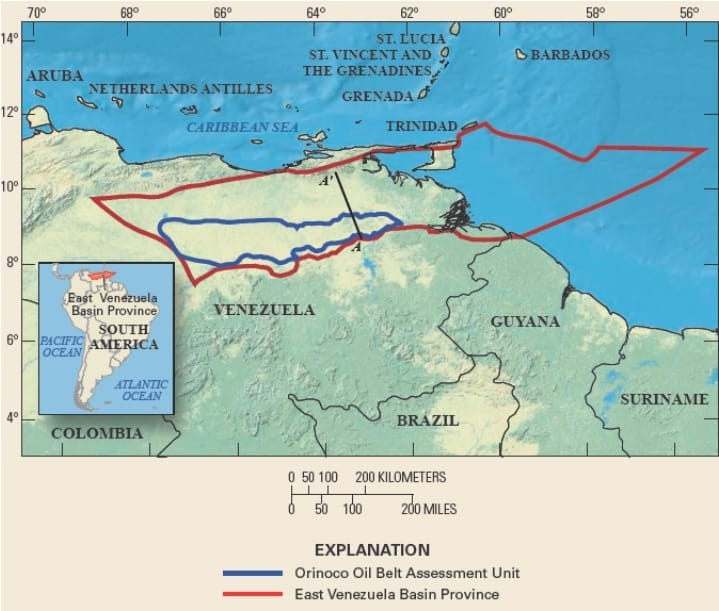
USGS, Public domain, via Wikimedia Commons
🇻🇪 🇺🇸 WASHINGTON’S RHETORIC VERSUS INTERNATIONAL LAW ON VENEZUELA’S OIL
Senior Trump adviser Stephen Miller has reignited controversy by suggesting that Venezuela’s oil “belongs” to the United States, echoing President Donald Trump’s declaration of a blockade on sanctioned Venezuelan oil shipments. The remarks come amid an expanded U.S. military posture in the Caribbean and a series of lethal maritime strikes Washington claims target drug trafficking—assertions Caracas and critics say mask an effort to exert pressure for regime change and resource control.
Why the Claim Is Being Made
Miller argues that U.S. capital and expertise built Venezuela’s oil industry and that subsequent nationalisation amounted to an unlawful seizure of American property. Historically, U.S. firms did play a central role in developing Venezuela’s oil sector in the early twentieth century, particularly after major discoveries around Lake Maracaibo. But that era ended decisively in 1976, when Venezuela nationalised its oil industry and established the state-owned company PDVSA, a move consistent with global norms at the time and followed by many resource-producing states.
What the Law Actually Says
Under international law, Washington has no claim to Venezuela’s oil. The principle of Permanent Sovereignty over Natural Resources, enshrined in a 1962 UN General Assembly resolution, affirms that states have exclusive rights over the resources within their territory. Nationalisation, even when it disadvantages foreign firms, is legal provided compensation mechanisms exist. Whatever the political grievances between Washington and Caracas, resource ownership is not in dispute in legal terms: Venezuela owns its oil.
Sanctions, Leverage, and Reality
U.S. sanctions, first imposed in the mid-2000s and expanded sharply after 2017, have crippled Venezuela’s oil exports and forced Caracas to redirect sales toward China and a handful of other buyers. Today, Chevron remains the only U.S. firm operating in Venezuela, under tightly controlled joint ventures and special licences. Trump’s rhetoric signals a more openly transactional approach to diplomacy, but turning political pressure into sovereign ownership would mark a clear breach of international law, and a dangerous precedent well beyond Venezuela.
Go from AI overwhelmed to AI savvy professional

AI keeps coming up at work, but you still don't get it?
That's exactly why 1M+ professionals working at Google, Meta, and OpenAI read Superhuman AI daily.
Here's what you get:
Daily AI news that matters for your career - Filtered from 1000s of sources so you know what affects your industry.
Step-by-step tutorials you can use immediately - Real prompts and workflows that solve actual business problems.
New AI tools tested and reviewed - We try everything to deliver tools that drive real results.
All in just 3 minutes a day
Other News
1️⃣ 🇰🇵 🇰🇷 Pyongyang accelerates conventional military buildup amid nuclear pause: North Korea has sharply intensified modernisation of its conventional forces, unveiling new warships, upgraded tanks, AI-enabled drones, artillery, and air defence systems. Backed by Russian funding, technology, and battlefield experience from the Ukraine war, Pyongyang is narrowing gaps in its conventional capabilities, reinforcing deterrence against South Korea without immediate nuclear escalation.
2️⃣ 🇨🇩 🇷🇼 M23 withdraws from Uvira: The Rwanda-backed M23 militia has begun pulling its forces out of the strategic town of Uvira in eastern DRC, saying the move follows a request from U.S. mediators seeking to salvage a fragile peace process. The withdrawal comes days after M23’s capture of the town threatened to derail a U.S.-brokered agreement between Kinshasa and Kigali.
3️⃣ 🇺🇸 🇹🇼 Trump administration approves $10bn arms package for Taiwan: The Trump administration has authorised more than $10bn in arms sales to Taiwan, including missiles, artillery systems, drones, and advanced military software, prompting a sharp backlash from Beijing. Washington says the package is intended to bolster Taiwan’s defensive deterrence and regional stability, while China condemned the move as a violation of bilateral understandings.
Weekly Updates?
Want weekly updates as well as daily?
Subscribe to our sister publication Geopolitics Weekly here ⤵️

Grow Your Audience With Us

Build your reach. Strengthen your brand.
We’ve helped brands, podcasts, and media organisations grow audiences using proven short-form video systems.
From scripting and editing to analytics and optimisation — every decision is driven by data, not guesswork.
Visit www.horizonatlasmedia.com to learn more.